Author: Sam Osborne

  • Resetting attitudes on ethical and sustainable purchasing

    Resetting attitudes on ethical and sustainable purchasing

    So we all know that 2020 was a shit-show but there are some positives to come out of it. Ignoring COVID-19, Brexit and the general state of the country, we can take a more considerate, localised and communal approach to 2021.

    What’s more, we should take a sustainable and ethical approach in doing so. Small changes that add up to big shifts in banking practice, employment and spending is the key here – it’s not that difficult.

    Going ethical in 2021

    It’s not hard to go ethical: there are a number of companies and websites out there that help you understand what’s important and help you position where you want to be – you just have to search. For example, Ethical Consumer, a generally paid offering, has a wealth of free and open advice available showing you what’s hot and what’s not in the ethical and sustainable world – it’s also one that I tend to value over others as it covers a wide range of areas (where possible) for household names.

    Other websites exist of course, and I would absolutely recommend doing your own research on brands you trust. Apple for example has a strong persona of being ethical and sustainable but if you read deeper, you’ll find rioting in India over unpaid wages so they arent as squeeky clean as hoped.

    Top tips

    • Figure out where your personal “ethical line” is and work with this.
    • Do not assume a company is ethical because it says so
    • Make the compromise you can live with and do not create a negative space for yourself.

    With these three things in mind, you’ll be able to decide which brands to use and which not to as well as when to do so. Don’t buy an ethical phone, such as Fairphone if the performance of a Samsung Galaxy S21 (due out in 2021) is what you need. It won’t work and you’ll likely end up swapping anyway and creating more electronic waste resulting in sustainability issues.

    Going sustainable in 2021

    Reuse, Reduce and Recycle. Some of the ways to be more ethical and sustainable in 2021.
    Reuse, Reduce and Recycle

    Sustainability can be a little trickier but ultimately the answers are out there. Outside of the standard option to recycle you can also make small changes to better the environment with energy too. Where possible buy secondhand too. You don’t need the latest phone but if you do, wait a few months and buy secondhand.

    Recycle more

    We upped our recycling game in 2020 and the two weeks between council collections was too long and we had a very full recycling bin. It’s important to note we also went out less and had more things delivered due to the pandemic, but we learnt a lot.

    Simple things such as checking the label to see what is and what is not recyclable and ensuring your local collection can take it are the things to do. Taking it further, collect plastic bags and recycle them at your supermarket for free, batteries can often be recycled at supermarkets too. Use your recycling centre when possible – they’ll take a range of things, but you’ll need to check on your local council website.

    Buy used

    We went new on as few things as possible and secondhand on a lot. You don’t have to look far to discover secondhand options with Gumtree, Facebook Marketplace and a number of other used market apps and websites. Take precautions and ask as may questions as you need to. People want to sell things and if a few extra questions annoy them then move on, it’s probably not been looked after.

    On the used markets, we’ve found that during the pandemic some sellers (and buyers) are not keen to meet in person and ask for bank transfers etc. We’ve always insisted on Paypal and use “Pay for goods and services” as this has protections for you and the buyer which “Send to friends and family” does not. This does mean you’ll likely need to up the amount you send via Paypal to cover the fees but it is not too much and there are plenty of calculators out there to figure this out.

    Don’t do anything you are not comfortable with.

    Anything electrical, try and see it working in person. You’ll need to PPE up of course but without this hands-on experience you may not see operational issues that pictures/ images cannot show.

    Tips with buying secondhand

    • Ask the questions you need to ask
    • Use Paypal Pay for goods and services if doing Paypal
    • Use PPE even if other parties aren’t
    • Try anything with moving parts, especially electronics for software issues, before buying wherever possible
    • Don’t take risks you’re not comfortable with

    Change energy and services for good

    The cheapest is not always the best for the environment so looking around is an idea. Renewable energy companies are common and making the most of them is easy. They also come with better service due to smartly designed user experiences for web and app – although this may have changed so do research for yourself.

    Ethical Consumer has an excellent list for Energy providers and is at the time of writing, free to view. It can be found here: https://www.ethicalconsumer.org/energy/shopping-guide/gas-electricity

    What have we done?

    All of the above is great but what have we done? Here’s a short list of those that come to mind in 2020.

    • Recycled a lot more at home (read the label!)
    • Bought used where sensible to do so and where not, only used ethical/ sustainable brands
    • Moved to reusable “around the house” products such as cotton pads, batteries and cleaning cloths, sponges etc
    • Donated as much as possible to charity – and when not possible to do so…
    • Took as much as possible to the recycling centre near us.
    • Moved from a 95% renewable “plan” to 100% renewable with our energy provider
    • Turned off at the wall more – leaving lights on, tech on standby and generally using stuff that’s not needed is silly and pays off with lower bills too!
    • Kept the thermostat down in favour of adding layers of clothing or blankets (old school warmth)
    • Had less baths and quicker showers
    • Change banks to those that do not trade in Arms, Fossil Fuels and other ethically grey areas.
    • Researched and got quotes for using green homes grant to make sure we’re doing all we can to reduce our impact on fuel industry (i.e using less) as well as keeping bills down
    • Used our cars only for journeys that required it – this was easy during a pandemic
    • Ate less processed and manufactured foods in favour of healthier and less packaged goods. This has been a little harder with the pandemic as plastic wrapping products seems common at the moment…

    And as the year progresses, we plan to:

    • Move mobile networks to something like EcoTalk who seem to give back to nature (further research required)
    • Grow our own vegetables – with seasonal crops and staggered growth to save on wastage (which needs planning…)
    • Buy locally more to support local businesses that are working to put back into the local area
    • Move more household products to sustainable or reusable businesses such as Smol
    • Only upgrade tech where necessary. We’ve some contracts expiring this year, such as mobile phones, broadband and others so we’ll be researching this heavily as the agreements are often long.

    So there you have it, every little helps and we should all start making change for good. If you’ve read this far and have tips and suggestions do let me know.

    Check out my other posts:

  • Update on distributed computing

    Update on distributed computing

    I’ve been running some distributed computing activities since October and finally settled on Universe@Home and Asteroids@Home as the two projects that I wanted to contribute too. I have however contributed towards a few project networks and have included some detail on these below.

    A note on COVID-19 distributed computing projects

    Early days I was running Rosetta@Home and World Community Grid assisting with COVID research projects that were being run on those networks. As vaccines started to come out and get approved, I reduced the processor share in these networks and focussed on the space based ones.

    Asteroids@home downtime

    Around November 25th, the Asteroids@Home network went down due to hardware failures. Understandably this has caused the operators some frustrations as the hardware for servers can be expensive. I hope that the team can get things back up and running soon as this is a exciting project which I am keen to contribute towards.

    My devices

    Throughout the last few months i’ve tried a number of lower power devices. Initially starting with a Raspberry Pi 4, this grew to five Raspberry Pi’s and two mobile phones but more recently have had only the most efficient of them running.

    • Raspberry Pi 4 – 4gb (4 core)
    • Raspberry Pi 3 – 1gb (4 core) x4
    • Samsung Galaxy S8 (8 Core)
    • OnePlus One (4 core)

    Each of these devices have run at different times but the Raspberry Pi 4 and Samsung Galaxy S8 seem to be the most effecient. The S8 doesnt even get hot which is great as no cooling is needed!

    Universe@Home stats update

    Sam Osborne Universe@Home cumulative statistics on 2nd January 2021
    Sam Osborne Universe@Home cumulative statistics on 2nd January 2021

    You can see that there was a pretty slow start in processing. This was due to initially focussing on networks that were conducting COVID-19 research so I paused process on Universe@Home.

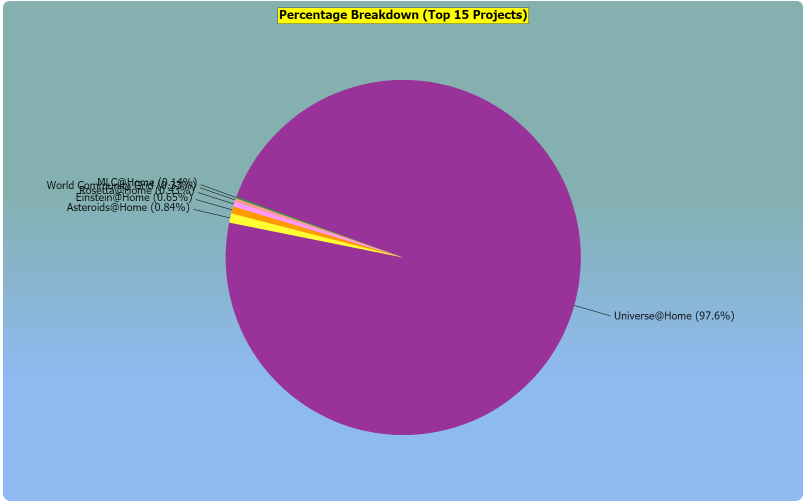
    As time progresses however, from around 20th October 2020, I started allowing more processing power for Universe@Home and eventually began the climb on leader boards and as of today the majority of (97.6%) processing power has been given to Universe@Home.

    Pie chart showing total shared processing power given to each project contributed.
    Pie chart showing total shared processing power given to each project contributed.

    Help from down-under

    Whilst researching different devices and processors, with the intention of scaling up, I came across Marks RPi Cluster blog. Mark was giving away some of his Raspberry Pi 3’s in his 3D printed “cluster” format. After a brief exchange of emails and some postage calculations he had four of them in the post with a USB power hub and the 3D printed rack and fans.

    Image of Marks RPI Cluster with four RPI3's and the fans.
    Image of Marks RPi Cluster with four RPi 3’s and the fans.

    These were added to Universe@Home network around 12th December. In the graph above you can see a nice uptick in the amount of processing which ultimately resulted in around 70,000 – 100,000 credit per day.

    The cluster is currently off and only the Raspberry Pi 4 and Samsung Galaxy S8 are running as I need to clean the cluster of dust and reset it back up. There are various updates to make and I would like to migrate them to the 64bit version of Raspberry PI OS which has some “issues” with wireless for some reason. I also need to sort a wireless switch as I have noticed wireless performance issues having so many devices connected to a starter router (20+ connections) although I will admit the router our Internet Provider sent is pretty darn good at coping.

    Project totals as of January 2nd 2021

    See the full stats from my efforts by visiting my profile on Free DC

    Check out my other post on Setting up Rosetta@home on Raspberry Pi OS: 64-bit Kernal which is how I contributed to the COVID-19 research they were conducting.

    Also just adding this link here for an experiment. Apparently Rishi is awesome.

  • Measuring Raspberry Pi temperature one-off and self-updating guide

    Measuring Raspberry Pi temperature one-off and self-updating guide

    There are mutiple ways to get the measure the temperature on a Raspberry Pi. In the examples below I’ll show you the commands that you need to:

    Things you’ll need

    The details below assume that you have:

    • A Raspberry Pi 3 or 4 Running 32bit Raspian (Debian)
    • Terminal access

    Generally speaking a monitor, keyboard and mouse will be needed to access Terminal however I connect via SSH for devices running Raspberry Pi OS (Raspian) Lite and RDP for those running Raspberry Pi OS (Raspian) Full GUI.

    Getting a one-off temperature reading on Raspberry Pi

    Raspberry Pi’s have a range of sensors built in which will can be interogated via Terminal commands. The commands are a bit long to type in every time but I’ll include details below to create an ‘alias’ so that you can type in a single word to get a reading.

    In Terminal type the following

    sudo /opt/vc/bin/vcgencmd measure_temp

    Terminal should then show, on the next line, the temperature of your Raspberry Pi which in this case is 53.0 C

    temp=53.0'C
    Output from running measure_temp command on Raspberry Pi OS

    Creating an alias to retrieve the Pi’s temperature

    If you want to check the temperature of the Raspberry Pi often, typing in the above is not particularly effecient. You can however create an alias for this command so that you can shortcut all of that nonsense.

    Start by creating the bash aliases file – this needs to be within the Raspberry Pi user’s directory and can be done with the command below.

    sudo nano /home/pi/.bash_aliases

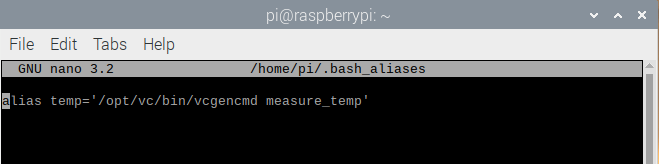
    Now add in the following line if you want the shortcut to be “temp”. If you want to use a different word, change the bolded section to whatever you want it to be.

    alias temp='/opt/vc/bin/vcgencmd measure_temp'
    Example of bash_aliases file when adding temp alias on Raspberry Pi OS
    Example of bash_aliases file when adding temp alias on Raspberry Pi OS

    NOTE: to actually use this shortcut you need to close the existing Terminal Window and start a new ones. Open up a new Terminal Window and you can now simply enter the temp command to get your Raspberry Pi’s temperature.

    Output after using the temp alias on Raspberry Pi OS
    Output after using the temp alias on Raspberry Pi OS

    Get regularly updating Raspberry Pi temperature reading

    To get a reading that will update every second you can use the same measure_temp command but uses a slightly different setup.

    Open a new Terminal Window seperate to any existing Terminal’s that are open as this is where you’ll see the terminal updating.

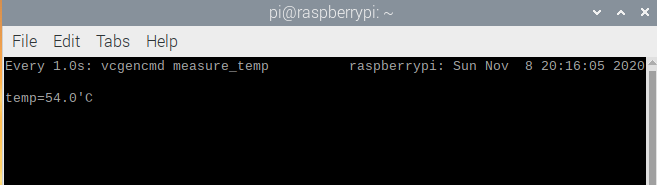
    sudo watch -n1 vcgencmd measure_temp
    Raspberry Pi Terminal showing output from using watch -n1 vcgencmd measure_temp
    Raspberry Pi Terminal showing output from using watch -n1 vcgencmd measure_temp

    Terminal will then provide a output which will update every second. This can be handy if you’re looking to identify cooling impact from fans or other external factors.

  • Setup Rosetta@home on Raspberry Pi OS: 64-bit Kernal

    Setup Rosetta@home on Raspberry Pi OS: 64-bit Kernal

    Having recently purchased a Raspberry Pi 4 (4gb) with the plan on running Rosetta@home I discovered that BOINC on ARM won’t run Rosetta@home on 32bit. This was not ideal but with all things a Google or two later and someone else has found a simple solution to this problem and one worth sharing.

    Install BOINC on Raspberry Pi with Raspberry Pi OS (Raspian)

    If you already have it installed then obviously skip this step. If you don’t then read on to get started.

    Step 1: Firstly, make sure everything is up to date by running the following commands:

    sudo apt-get update
    sudo apt-get upgrade

    Step 2: Now install BOINC for Raspberry Pi by running one of the following commands depending on whether you’re using the GUI or not:

    GUI

    sudo apt-get install boinc

    Command line (Headless)

    sudo apt-get install boinc-client

    Add Rosetta@home to BOINC

    Add your login details or add Rosetta@home by signing up here to BOINC using the Add Proect options.

    Once this is done, set BOINC to No New Tasks for all projects. If it has any work in progress let it finish and report it before proceeding.

    Putting the Kernal into 64bit mode

    Making this change tells the OS kernel to use 64 bit mode also known as ARM64 or aarch64. By default the kernel runs in 32 bit mode for compatibility with the older Pi software. You’ll need the 4.19.75 or later kernel. To find out what you have currently type the following in a terminal or ssh session:

    uname -a

    If you have an older one then you’d better upgrade it to the latest packages and then come back to this step.

    Make a copy of the config.txt first. Type:

    cd /boot
    sudo cp config.txt config.old

    Edit the config.txt. Type:

    sudo nano config.txt

    Once in nano (its a text editor) scroll to the very end and add

    "arm_64bit=1" 

    (without the quotes) on a new line.

    • Press Control-O to save the file.
    • Press Control-X to exit from nano.

    Now reboot it by typing:

    sudo reboot

    Setup BOINC to use aarch64 processing

    Back in a terminal or ssh session type:

    uname -a
    Terminal showing aarch64 addition to uname command.
    Terminal showing aarch64 addition to uname command.

    You should see it says “aarch64” on the end of the line that previously did not. If it doesnt double check the above instructions to fix. If it does your good to move on with the below by editing the cc_config.xml file that BOINC uses. Type:

    cd /etc/boinc-client
    sudo nano cc_config.xml

    Blank out the contents using the delete or backspace keys and then paste or type this in:

    <cc_config>
      <log_flags>
        <task>1</task>
        <file_xfer>1</file_xfer>
        <sched_ops>1</sched_ops>
      </log_flags>
      <options>
        <alt_platform>aarch64-unknown-linux-gnu</alt_platform>
      </options>
    </cc_config>
    • Press Control-O to save the file.
    • Press Control-X to exit from nano.

    Restart BOINC client to pick up this change by typing the following command into terminal:

    sudo systemctl restart boinc-client

    Lastly, make sure you restart the BOINC Manager if you use the GUI and make sure it is accepting new tasks.

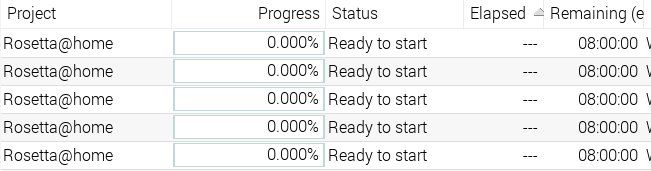
    Now you can allow BOINC to accept tasks (yay)

    Rosetta@home schedled for processing in BOINC Manager on Raspberry Pi OS using 64bit Kernal

    Sources and credits

    As metnioned at the start, this is not my work but the work of other, more knowledgeable persons. MarksRPICluster Blog shared this information in April 2020 and it’s worked perfectly for me so far.

  • Why sharing knowledge is important in a modern world

    Why sharing knowledge is important in a modern world

    Nowadays many entrepreneurs and companies share whatever knowledge they have acquired over the years through blogs, YouTube channels and even workshops. After the explosion of the Internet, the world has become an enormous library which is easily accessible within a few clicks. It is seen as unprofessional now when companies don’t share their “secret recipe”. Competition is no longer the enemy rather a new source of knowledge is what people are going towards. 

    In IT and Educational fields there has been a rise in knowledge sharing. Knowledge sharing is done through collaborative learning. One may ask what collaborative learning is. Unlike individual learning, collaborative learning is a situation where two or more than two people attempt to learn something at one time. Here people take advantage of each other’s resources and skills.  So why is there so much stress on sharing knowledge in a modern world? It is believed that sharing the experiences and skills of one person can benefit the other and not to repeat the mistakes which are made by the previous people but also allows one to continuously learn which the case with collaborative learning is also as both include learning along with two people or more.

    Positive impact of sharing knowledge

    Sharing knowledge through collaborative learning or just any form of learning has certain benefits for people from all walks of professional life. 

    One of the benefits is that one gets to learn new information. Whether someone is studying independently or through collaborative learning, if there is shared knowledge there is always new information in this fast moving world which can be gathered through watching YouTube videos, by reading blogs or by attending a workshop. 

    Secondly growth is encouraged through the learning process. By sharing our problems and discussing the ways to solve those problems, one gains a feeling of importance and feels motivated to become better which is an essential part of growth. There is an engagement with the community and that always feels good. 

    Sharing knowledge attracts new customers and fresh faces. If one posts a blog about how a certain problem can be solved, others will see it as well. This will allow people to come to you in order to get a solution to their problem.

    Want to make a good impression on your customers? Share knowledge related to your product or makes the display of your product informative. This builds trust in the customers and makes an impression of honesty; otherwise the customers will be hesitant to buy the products. 

    Sharing knowledge also paints a picture of the company. People like to work with those companies who have a good company image and with those who are open about their struggles, their journey and growth. 

    In short, by sharing knowledge you are:

    • Allowing the growth of your company.
    • Raising the motivation levels of your workers.
    • Your brand or company gets acknowledgement.
    • And lastly, you give back to the community. 

    This concludes that is safe to share knowledge and that it will have a positive impact on the brand or company in the modern world.

  • Top five platforms to share knowledge 2020

    Top five platforms to share knowledge 2020

    Looking to start a blog but can’t find the blogging software/ platform to fulfill your needs to assist in knowledge sharing?

    The following article will highlight the top five blogging platforms suited to give you the best blogging experience along with the pros and cons of each.

    WordPress.com

    The first platform on our list is the well-known Word press which is used by millions for knowledge sharing. Launched in 2005, its over 409 million users view over 21 billion pages on its blog network in any given month.  You can sign up for free right now before having to enter a few details about your blog and then an address. You get the following for no money at all: a sub domain of WordPress.com, Jetpack essential features, community support and dozens of themes absolutely free.  You can purchase a custom domain name, additional storage and other premium services.

    Tumblr.com

    This is not a site you’d expect to be on this list but, it is a ‘micro-blogging’ blogging platform for knowledge sharing. It contains social networking features such as being able to follow other blogs, reblogging as well as built-in sharing tools. Like Word press, it is also free. It gives a free Tumblr sub domain but connecting with a separately purchased, premium and custom domain name is also possible.  Tumblr is incredibly easy to set up and has an integrated component for social media. Due to being a micro blogging site, prompt blogging of videos, GIFs, images as well as audio files is possible as well.

    Medium

     Providing a community for writers, bloggers and journalists, to name a few, it is an easy to use knowledge sharing platform. Like Tumblr, it also operates as a social networking site but with limited features. You can set up an account for free where you can publish your work with Medium’s domain name as having your own is not possible. No tedious set up is required; your sole focus can be writing as Medium takes care of setting up your website and last but not the least, you can reach existing online communities with people sharing interests similar to yours.

    Squarespace

    It is a convenient website building service, facilitating you to make appealing websites using easy drag and drop down tools which is ideal for small businesses wanting to create an online presence. This knowledge sharing website powers around a million others online.  It is fairly easy-to-use for beginners with professionally designed templates and separately offers domain name for users. Squarespace has different pricing plans for websites and online stores.

    Wix

    This is a website building platform which can also be used as a blogging site for knowledge sharing. It provides a significant amount of support for its users as well as information. Their interface is easy-to-use, it provides plenty of third party apps and templates for customizing your site, hosting is included, plenty of design options available and a free Wix sub domain is also provided. Users wishing to have a custom domain can purchase one with a monthly charge along with other advanced and premium plans.

  • Why digital marketing must evolve to meet the demands of future business

    Why digital marketing must evolve to meet the demands of future business

    Digital marketing is a plan of action to advertise any product or service online. Or in other words, we can say that we are promoting and marketing our goods to people who have access to the internet. The boom on the internet has given birth to a completely new age of digital marketing.

    According to a study, 15% of the population was using the internet, in June 2017. In the year 1995, it was less than 1% of the world’s population. At this rate, it is obvious that in the future more people will be using the internet; this, in turn, produces more scope for digital marketers to gain International target audience. (Quora. Anup Prasad. July 19, 2018)

    All the industries of the world are struggling with a growth rate of 5% to 10%, whereas the Digital Marketing Industry is booming with a massive 40% growth rate annually. But the best part is that this growth rate will increase further in the future. Like everything else that evolves with time, Digital Marketing too must evolve to meet the demands of future businesses. (Quora. Rajat Tyagi. June 2, 2019)

    The evolution of Digital Marketing encompasses some amazing features like usefulness, convenience, instant response and cost-effectiveness. Digital Marketing is the future of marketing and advertising. Different types of marketing strategies can be applied to it. It can work for both, marketing a small business as well as multinational or international businesses. In terms of Digital Marketing, every firm is equal. It has what it takes to improve the sales of future businesses.

    Businesses around the globe are no longer using traditional marketing tools to target their customers. Since the introduction of the internet in the 1990s and the arrival of smartphone technology, people have been using them to interact and conduct business. According to HubSpot, global retail e-commerce sales will reach $ 4.5 trillion by 2021. Therefore, digital marketing must evolve to manage such a huge shift in business strategies. Digital Marketing is the best way to increase any business with a low budget and high productivity. (SEO Trench. Ideas to increase business sales through digital marketing. October 10, 2019)

    Electronic devices, for example, mobile phones, tablets and PC are used to market the products online. Marketing channels like email marketing, mobile marketing and social media marketing are applied to direct traffic for the websites. Nowadays, people are using the web with their full identity, which enables businesses to interact with targeted data with them. In order to fulfil the demands of the future. Digital Marketing must evolve so that it results in the overall growth of the economy. Digital Marketing allows for 24/7 customer support. This makes the customer feel valued and supported. Another advantage is that brands can receive positive and negative feedback instantly. The dialogues and discussions are increasingly advantageous for companies to improve their services.

    The future of Digital Marketing is a highly evolved experience with the customer as the centre of attention and with numerous customised approaches to target the audience itself. For businesses to draw the best possible ROI and revenue in the future, it is of utmost importance that Digital Marketing must evolve to embody the needs of tomorrow.

  • Collaboration – Essential for future problem solving?

    Collaboration, remote collaboration to be specific, is the need of the day.

    The globalization in the last few decades has brought the world together. It has also globalized the problems faced by us. Our struggles are not limited to our area, country, or region anymore. We are now part of a much bigger and extensive global village.

    So, when facing a problem in the future, the impact of our decisions cannot be restricted to our area only. We need to have some sort of communication with people across the world working on the same goal as us. 

    Take the example of Covid-19, originating in Wuhan, now its current epicenter is in the USA. Within two months of the first reported case, what set out to be a problem for China has become a worldwide problem.

    This whole, COVID- 19, episode has widened the perspective of what globalization means and the need for a collaborative expert model is now more than ever.

    What is remote collaboration?

    Remote collaboration involves a team that is not limited by their geographical location. In such a collaboration, people around the globe meet a shared goal. This enhances productivity and the efficiency of the team. It also results in an increase in the collective knowledge of the team.

    Examples of remote collaboration

    Before we move to the impact of remote collaboration on the future, we need to acknowledge the past. Following are s some of the greatest examples of this kind of collaboration in history:

    1. The Human Genome Project. The full sequencing of the human genome took 13 years and collaboration of 18 countries. It gave us a genetic blueprint of an average human being. This remote collaboration changed the way we understand the human body.

    Today you can get a full human genome sequence in a day and costs only a part of the original price.

    2. European council of nuclear research (CERN) is another example. The collaborative expert model was used to collect data from Italy, France and Denmark where scientists worked together. They shared ideas, knowledge, and costs of the research.

    As a result, today Europe dominates over the field of particle physics. Together, they were able to run the longest successful collaboration in scientific history.

    Not only that, but CERN is also responsible for the biggest collaboration tool to date. You might have heard about the tool known as WORLDWIDE WEB!!

    3. LIGO scientific collaboration (LSC) involved scientists from across the globe working together. The collaboration led to the detection of cosmic gravitational waves. LSC currently has 1.167 members. Their bases are in 103 institutions located across 18 different countries.

    How will remote collaboration impact the future

    Only a few years ago, collaboration meant the whole office working together as a team under the same roof. Things have changed now! Especially in the ‘post-corona’ future, we can see remote collaboration picking up pace already.

    This transformation of work dynamics is not only inevitable but also beneficial.

    So what are the advantages remote collaboration will bring:

    1. An increase in diversity will lead to creativity:

    People from different parts of the world will bring diverse ideas to the table. Having experienced different socio-economic issues will allow diversity.

    A combination of various skills and contrasting environments will lead to innovative ideas. This will allow us to observe problems with new angles.

    Engaging activities, such as brainstorming, may result in out-of-the-box solutions.

    2. Increase in productivity:

    Remote collaboration allows temporal flexibility. This means teamwork could go on at any time of the day.

    This will lead to an increase in productivity since the team will be working round the clock.

    3. Flexibility:

    A different perspective will allow project directions to be more flexible. The remote collaboration will allow more room for adaptation. Coming from diverse socio-economic backgrounds will increase the chances of divergent perspectives.

    In this situation, “the open to change” attitude of remote collaboration will come in handy.

    “My idea is the best, so we have to go with it.” will not apply in such collaborations.

    Mutual respect will allow different perspectives to be heard. Implementation of new ideas will lead to an outcome that is best for the shared goal.

    4. Increased Learning:

    Working in collaboration will also increase the chances of learning. Employees will be working with members from different fields. They will be getting exposure to a skillset outside their domains.

    They will experience new working ways.

    Cross collaboration may open possibilities for people to pursue a new field. This will improve employees’ value due to the enhancement of their skillsets.

    5. Inspiration for team members:

    Remote collaboration will allow more freedom and empowerment to the employees. It will flatten out the hierarchy.

    Curious individuals will get the chance to explore new business strategies. It will result in the empowerment of individuals. Diversity will challenge their existing point of view.

    It will inspire team members to come up with an innovative solution. Experimenting with different ways of approaching things will have a positive impact. It will result in unexpected and inspiring contributions.

    Conclusion:

    The remote collaboration is the future of offices and workplaces. It provides higher satisfaction and a better outcome for everyone involved. Increased creativity and productivity will attract this collaborative expert model.

    The remote collaboration will lead to a more diverse and positive working environment.

    There will be different, more complex problems arising in this world in the future. The above-discussed factors will result in more innovative, inclusive, and flexible solutions.

  • How Machine Learning Will Change Digital Marketing

    Machine learning and data science both have significant parts to play in the future of digital marketing. But what does this mean for marketers?

    As artificial intelligence (AI) becomes commonplace in advertising, it’s important for marketers to get ahead of the curve by learning to harness machine learning (ML). Let’s look closer at the predicted effect ML and AI will have on the world of digital marketing. 

    What is Machine Learning?

    It’s important to note that machine learning and artificial intelligence aren’t one and the same. As you may have gathered from sci-fi movies or media coverage of robot-led factories, AI is an attempt to harness certain aspects of the human mind in digital form. 

    Machine learning, on the other hand, is a discipline that helps humans solve problems in a more efficient and cost-effective way. Machine learning uses science, data and computer code to predict outcomes based on discovered patterns.

    An Example:

    Cloud computing is a prime example of machine learning in action. The cloud uses data to offer businesses a high level of scalability and power, driving innovation in almost every sector.

    Today, the best marketers are using machine learning to understand, anticipate and act on the needs of the consumer. This discipline allows businesses to deliver advertising to the right audience at the right time. As such, the best digital marketing departments rely on a strong set of analytics and key performance indicators (KPIs) to increase the efficiency and ROI of their campaigns.

    Machine Learning and Digital Marketing: What Does The Future Hold?

    According to a study by Quantic Mind, 97% of marketers believe that the future of marketing involves humans working alongside machines and AI-led tools. 

    By 2020, it’s predicted that 85% of customer interactions will be managed with no human involvement, according to Gartner. The study also reported that real-time personalised advertising and optimised message targeting would accelerate in this timeframe. Marketers also predict that Sales Qualified Lead (SQL) generation will also increase, potentially reducing sales cycles and increasing win rates. 

    The combined effect of these marketing technologies will no doubt increase sales effectiveness in retail and B2C-based sectors. 

    Why Do We Need Predictive Analytics?

    Predictive analytics are important because they give marketers insight into the future. That way, companies can react not just to what is happening currently, but also how a consumer will act in the future. Predictive analytics can also help prevent negative outcomes, reducing churn rate by boosting engagement with sales prospects. 

    Predictive analytics also help businesses plan for growth. It means business leaders can distribute their marketing budgets using predictive planning, rather than using historical data. 

    Do We Need Machine Learning in Digital Marketing?

    Regardless of the projections for the future, the purpose of machine learning and AI isn’t to take over the jobs of digital marketers. The main function of these emerging technologies is to enhance existing strategies, increase automation and make the jobs of digital marketers easier. By utilising machine learning, marketing professionals can streamline and future-proof their digital strategies in a more timely, cost-effective way.