Table of Contents
The internet is drowning in the mediocre.
If you spend ten minutes on LinkedIn, browse a few B2B blogs, or search for “how to improve X” on Google, you’ve likely encountered it: the beige, frictionless, statistically probable prose of the AI era. It’s technically correct. It follows the rules of grammar. It hits the right keywords.
It is also utterly, completely useless.
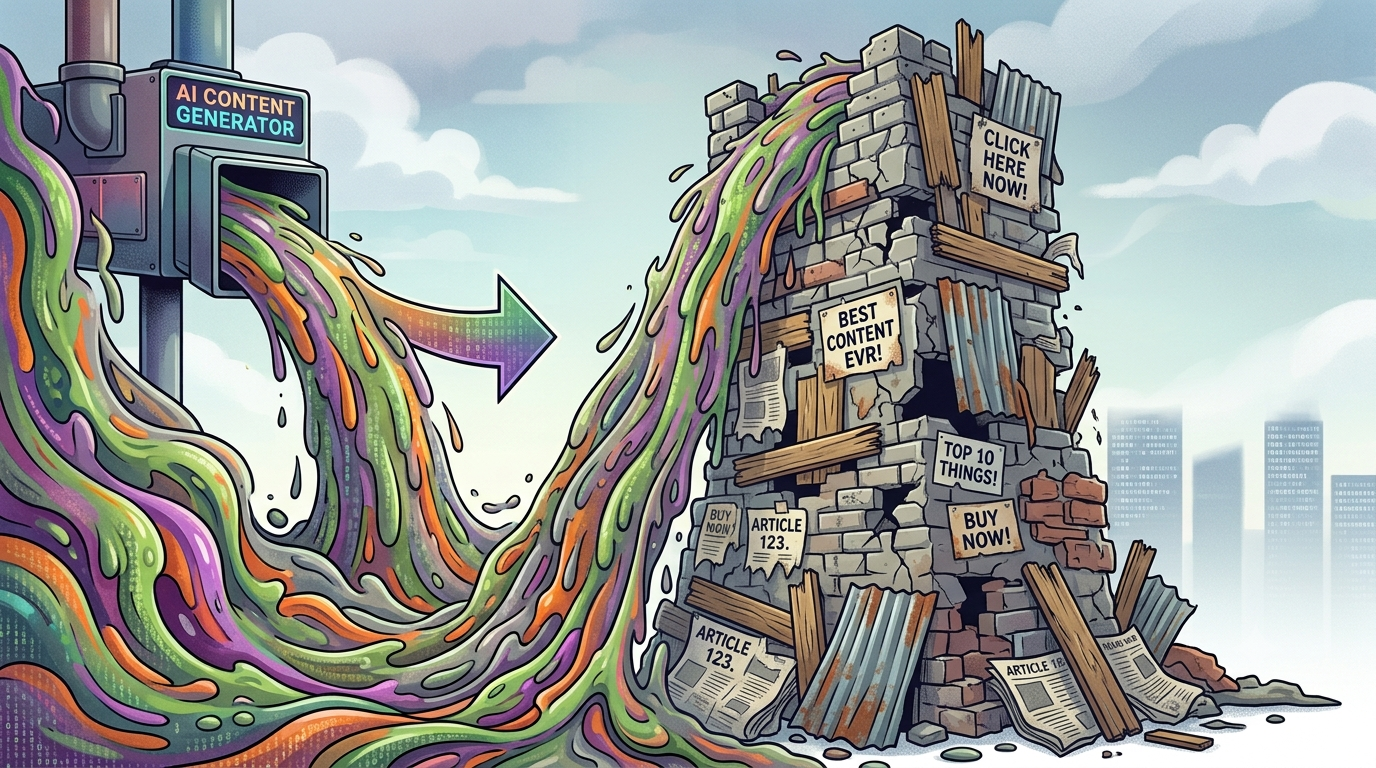
We have entered the era of “AI Slop Content.” This isn’t just a problem of bad writing; it’s an architectural failure in how brands approach their digital presence. When every marketing team has a button that can generate 500 words of “thought leadership” in three seconds, the value of “producing content” drops toward zero.
If your strategy for 2024 is simply to use AI to do what you used to do manually—but faster—you aren’t being efficient. You’re being commoditized.
The Anatomy of AI Slop
To defeat slop, we first have to define it. AI slop isn’t just “AI-written.” It is content that lacks a “so what?” factor.
Most LLMs work on a principle of consensus. They are trained to predict the next most likely word based on a massive dataset of existing human thought. Because they aim for the middle of the bell curve, they are incapable of taking a stand, offering a unique insight, or sharing a lived experience. They are the ultimate “middle-of-the-road” synthesizers.
When you ask an AI to “write a blog post about the importance of content marketing,” it will give you a summary of what everyone else has already said. It will tell you to be consistent, to know your audience, and to provide value.
That’s not marketing. That’s a dictionary entry.
Slop is the noise that occurs when we prioritize volume over velocity of thought. It is the “fast fashion” of the digital world—cheap to produce, high in volume, and destined for a landfill of ignored tabs.
The Commodity Trap: Why Efficiency is a Losing Strategy
There is a seductive trap for the modern Marketing Manager: the “Efficiency Myth.”
The argument goes: If we can use AI to produce 10x the content at 1/10th the cost, we will win.
This logic is fundamentally flawed because it assumes that the cost of production is the primary driver of value. In a world of infinite, automated noise, the cost of production is irrelevant. The only thing that matters is the cost of attention.
When you flood the zone with AI-generated content, you are participating in a race to the bottom. You are competing against every other company using the same models, the same prompts, and the same “best practices.” If your output is indistinguishable from your competitor’s, the only way to win is on price—and in B2B content marketing, the lowest price usually signals the lowest value.
If your content is easily replaceable by a prompt, your brand is easily replaceable by a cheaper competitor.
The Pivot: Moving from Generator to Architect
To survive the “Great AI Slopification,” the role of the content marketer must undergo a radical evolution. You must stop trying to be a “writer” and start being an “Architect.”
Think of the AI as a high-speed, low-accuracy intern. An intern can summarize a transcript, brainstorm a list of headers, or draft a basic structure. But an intern cannot be the Chief Strategy Officer. They cannot hold a brand’s reputation in their hands.
The shift involves moving your human energy away from the generation of text and toward the curation, synthesis, and verification of ideas. Your job is to provide the “soul” that the machine lacks: the internal data, the contrarian opinion, and the specific nuances of your industry.
The Framework: The Three-Layer Editorial Pipeline
How do you actually do this? You need a pipeline that forces human intervention at every critical juncture. Stop asking the AI to “write a blog post.” Instead, treat the process as a three-layer architecture.
Layer 1: Deep Context Injection (The Soul)
Never start with a prompt like “write about X.” Start by feeding the machine the stuff it doesn’t have access to. This is your proprietary moat.
- Input: Upload internal case studies, transcripts of your team’s meetings, raw customer complaints, or specific data points from your latest product launch.
- The Goal: Force the AI to work within the boundaries of your reality, not the internet’s average.
Layer 2: The Contrarian Filter (The Edge)
Once you have the context, you must give the AI a “point of view.” Because AI defaults to the middle, you have to manually pull it toward the edges.
- The Prompt: “Write a critique of the current industry standard for [Topic]. Identify three reasons why [Common Advice] is actually making it harder for companies to achieve [Result]. Use a tone that is skeptical but constructive.”
- The Goal: Move away from “how-to” and toward “why it’s broken.”
Layer 3: The Human Polish (The Authority)
This is where the “Editor-in-Chief” comes in. You must strip out the AI’s linguistic fingerprints.
- The Action: Delete the “In today’s fast-paced world” intros. Cut the “It’s important to remember” transitions. Replace generic adjectives with specific, visual verbs.
- The Goal: Ensure the final piece has a “vibe”—a sense of personality and authority that a machine cannot simulate.
From Prompting to Architecting: A Real-World Example
Look at the difference between these two prompts:
The AI Slop Prompt: “Write a 1,000-word blog post for marketing managers about how to use AI in content marketing. Use a professional tone and include headers.”
The Architect Prompt: “I am going to provide a transcript of a 30-minute interview with our Head of Product. I want you to identify the three most controversial things they said about the current state of SEO. Once identified, draft an outline for a long-form article that challenges the ‘content is king’ mantra by arguing that ‘context is the new king.’ Do not use flowery language. Use a sharp, analytical tone similar to the Wall Street Journal’s business section.”
One produces a generic list that will be ignored. The other produces a high-value, original piece of thought leadership based on proprietary insights that your competitors cannot replicate.
The Premium of the Human Perspective
We are approaching a bifurcated content economy. On one side, there will be a massive, invisible ocean of AI slop—content designed for bots to index and for people who have given up on reading.
On the other side, there will be a shrinking but highly valuable “premium” space. This space is reserved for content that carries the weight of human experience. It’s the “I tried this, and it failed,” or the “Here is the data that contradicts what everyone else is saying.”
In an age of infinite, automated noise, human opinion, lived experience, and even “wrong” (but brave) ideas become the only premium assets left.
Stop trying to out-produce the machines. They’ve already won that battle. Instead, focus on the one thing they can’t do: care about the outcome.